Graftum Pocket
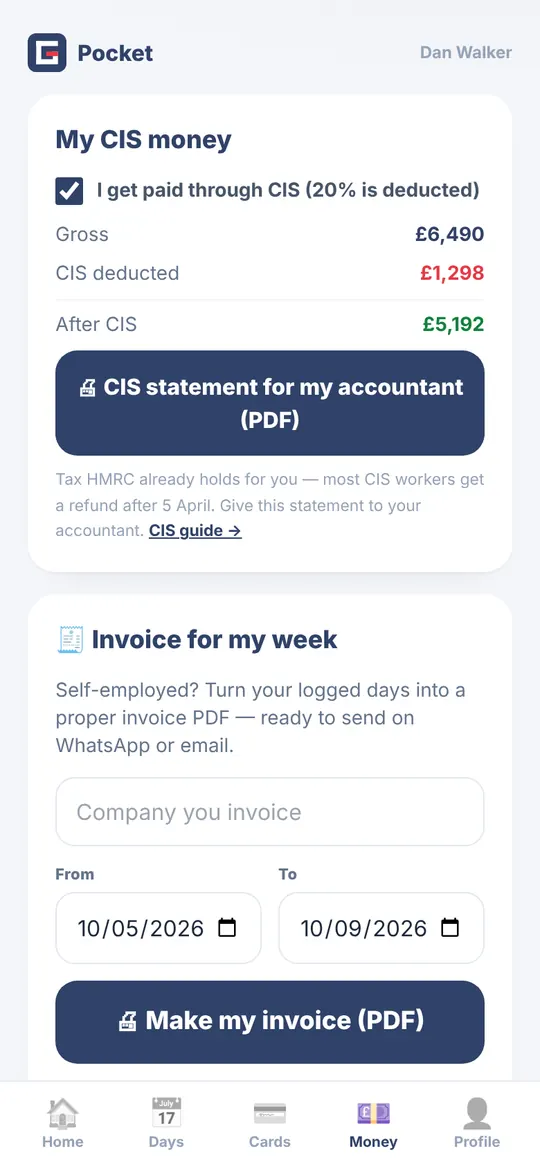
Keep your CIS money in order — free
- See the 20% taken off and your total for the tax year
- Snap every receipt — expenses raise your refund
- One PDF statement for your accountant
Free forever, in 7 languages. See how it works
Before you start on site, the firm or agency must check you're allowed to work in the UK. For most non-British workers that means a free share code from GOV.UK — there's no paper card any more. Here's what you need, in plain words.
Show your passport or passport card (it can be expired). You can't get a share code — the firm checks your passport in person or through an ID app.
Your status is digital, in your UKVI account. Get a share code online and give it to the firm. Both settled and pre-settled status let you work.
Your visa is an eVisa now. Sign in to your UKVI account, get a share code and check what work your visa allows.
Search “prove right to work” or open gov.uk/prove-right-to-work. It's free and official — never use a site that charges you.
Use the passport or national ID card linked to your UKVI account (or your UKVI customer number). You'll get a security code by text or email, so have the phone and email you registered with.
Choose the right to work option. You get a share code that lasts 90 days and can be used as many times as you need. You can make a new one any time — free.
They check it on GOV.UK, see what work you're allowed to do and until when, and keep a record. They'll also check the photo is you (in person or by video call).
Not proof of right to work: your National Insurance number, UTR, CIS registration, CSCS card or bank account. You need them to work and get paid, but they don't show your immigration status.
All BRP cards have expired and been replaced by eVisas — a digital record in your UKVI account. Firms can't accept a BRP card as proof any more; they need a share code.
No UKVI account yet? Create one free on GOV.UK (search “get access to your eVisa”). You need a phone number, an email and normally your passport. An expired BRP can still be used for a limited time to set up the account or get a share code — no later than 31 December 2026 (check GOV.UK).
BRP lost or stolen? Report it on GOV.UK even though it's expired — if you don't, you risk a fine of up to £1,000. Found it later? Don't use it; cut it up.
Applied to the EU Settlement Scheme? You already have a UKVI account — don't make a second one. Keep your passport, phone and email up to date in it.
Settled status = you can live and work in the UK with no time limit. Pre-settled status = you can work too, without restrictions.
Pre-settled status no longer simply runs out: the Home Office moves some people to settled status automatically (using tax and benefit records) and extends others by 5 years. Since April 2026 it can also remove it from people who have clearly left the UK for a long time. Keep your email and phone up to date so you don't miss their messages.
You can apply for settled status yourself as soon as you have 5 years' continuous residence — it's free.
Never applied? The deadline for most people was 30 June 2021. Late applications can still be accepted if you have “reasonable grounds” — get free advice first (see below). While your application is pending, your certificate of application lets you work.
Employed (PAYE) or through an agency: the employer or agency must check you before day one. This has been the law for years.
New since 1 October 2026: the rules now also cover casual and zero-hours workers, individual subcontractors and people who find work through apps or platforms (Border Security, Asylum and Immigration Act 2025, section 48 — already in force). So if you work for a contractor as a self-employed CIS subcontractor, the contractor must check your right to work too.
Not covered: people genuinely running their own business and working directly for their own clients (for example a homeowner who hires you for a job). A firm calling you “self-employed” doesn't get it out of the check — what counts is how the work really happens.
Firms face fines of up to £60,000 per worker without a correct check, so every main contractor and agency will ask. It's normal — it doesn't mean they don't trust you.
The new rules mainly cover work that started on or after 1 October 2026, but many firms now check everyone on site.
Check your visa conditions too: some visas only let you work for your sponsor or for limited hours. The share code shows exactly what you're allowed to do.
A proper firm checks your right to work correctly and pays you through CIS or PAYE. See in 10 seconds whether the company is real and active on Companies House.
Check a firm — free90 days. You can use it as many times as you need in that time and make a new one whenever you want — free on GOV.UK.
No. All BRPs have expired and firms can't accept them. Use your eVisa: sign in to your UKVI account and get a share code. An expired BRP can still help you sign in for a limited time (no later than 31 December 2026).
Yes, if you work for a contractor. Since 1 October 2026 the right to work rules cover individual subcontractors, not only employees. Only people genuinely running their own business for their own clients are outside the rules.
No — you can't get one. Show your passport or passport card (expired is fine), or a UK or Irish birth certificate plus an official letter with your name and National Insurance number.
No. Your NI number, UTR and CIS registration are for tax. They don't show your immigration status — the firm still needs a share code or your passport.
Official sources: GOV.UK — Prove your right to work, eVisas, EU Settlement Scheme, Employer's guide to right to work checks (1 October 2026). Checked October 2026 — general information, not legal advice. Rules change: always check GOV.UK.
Graftum keeps each person's right-to-work check date, cards and CIS status in one place — and their clock-ins become the pay run.